User Research
Persona Building
Brand Research
Microcopy Writing
Headspace is a meditation app that helps people manage stress and build mindfulness. For my final UX Writing class project, I wanted to explore how Headspace’s microcopy contributed to the experience and where it could be strengthened.

To evaluate Headspace's microcopy, I first needed to understand three things: the brand's intended voice, the voice users actually experience, and the audience the content is written for.
The Intended Voice.
I reviewed Headspace's About Us page and statements from company leaders to understand the brand's goals and tone. Headspace describes itself as "a lifelong guide to better mental health" (About Us, n.d.), while CEO Tom Pickett emphasizes mental health support that is "intelligent, safe, and personal" (Pickett, 2025).
The Audience
I reviewed demographic and user research to understand who regularly uses Headspace. Studies showed that many frequent users were between 26 and 59 years old, often came from higher-income households, and were more likely to have ongoing mental health challenges (Borghouts, 2025; Edwards, 2025). Based on these findings, I created the user persona shown alongside this section.

The Actual Voice
This required reading through the website and evaluating the content. I discerned that the voice had three essential traits:
Empathetic

In this section, Headspace’s language includes phrases like “emotionally tapped-out”, “relationship burnout” “two-way street” as a way for the service to speak to the user as a peer (“Building Healthier Relationships”, n.d.). Additionally, Headspace’s questions, such as “can I run out of compassion?” reflect the user’s thoughts back at them, so that Headspace may appear to relate to the user(“Building Healthier Relationships”, n.d.).
Calm

Rather than state that the user is panicked or anxious, Headspace states that your mind is “unquiet” or “unsettled”. Gentle words like that ease a user’s emotions and helps them engage with the exercises.” (“Quiet Mental Chatter”, n.d.).
Expert

In the “Radio Headspace” conversations section, Headspace details multiple activities by listing the credentials of the speaker and the clinical name of the concept they discuss. Headspace sacrifices succinctness to evidence its expertise, which helps build the user’s trust in the service (“New and Popular”, n.d.).
When these three traits are viewed together, a problem becomes evident.
The Expert Voice:
Prioritizes academic language over user language.
Delays getting to the point.
Uses action as nouns rather than as verbs.
The Empathetic Voice:
Presents information clearly and quickly.
The expert voice sometimes undermines the empathetic voice, resulting in an experience that feels inaccessible or condescending.
I needed to revise the content so that it could address these issues using plain language. Plain language in this case is achieved with the following: makes terminology familiar, clarifies its actions, brings subjects and verbs closer together.
1. Make Terminology Familiar
The microcopy should introduce users to academic terminology through familiar terms.

2. Clarify Actions
The microcopy should replace action nouns with action verbs, so that readers understand the activities the exercise involves.
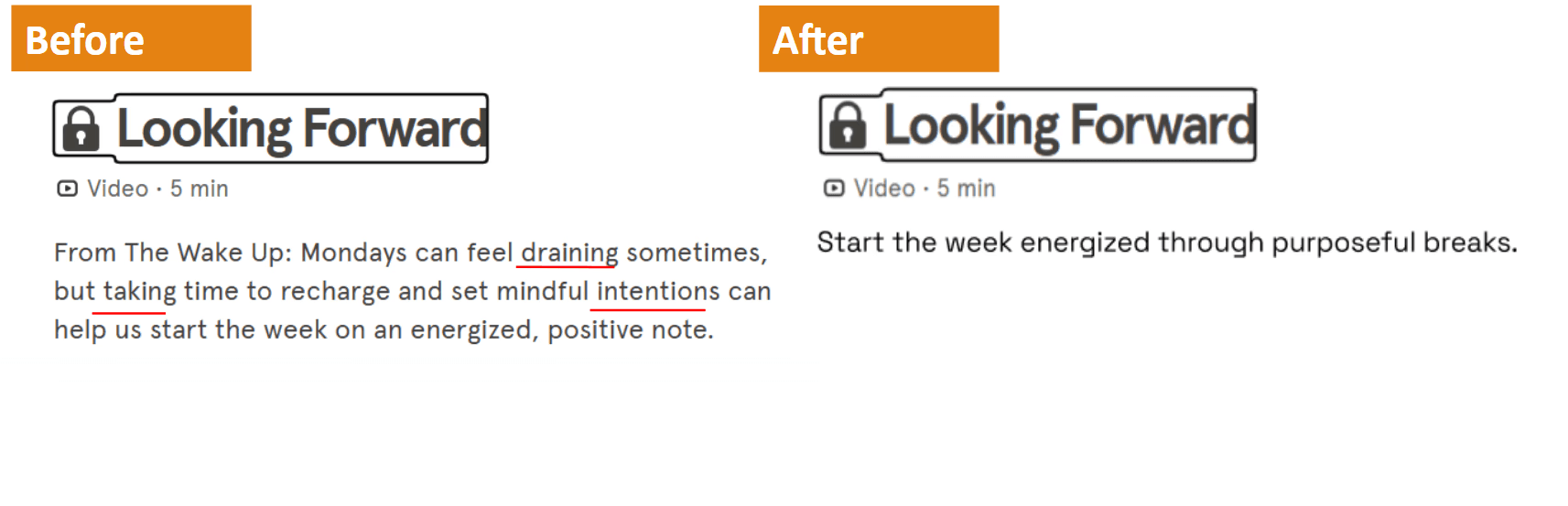
3. Keep Subjects Close to Actions
Bring subject and action close together to clarify the connection between them.
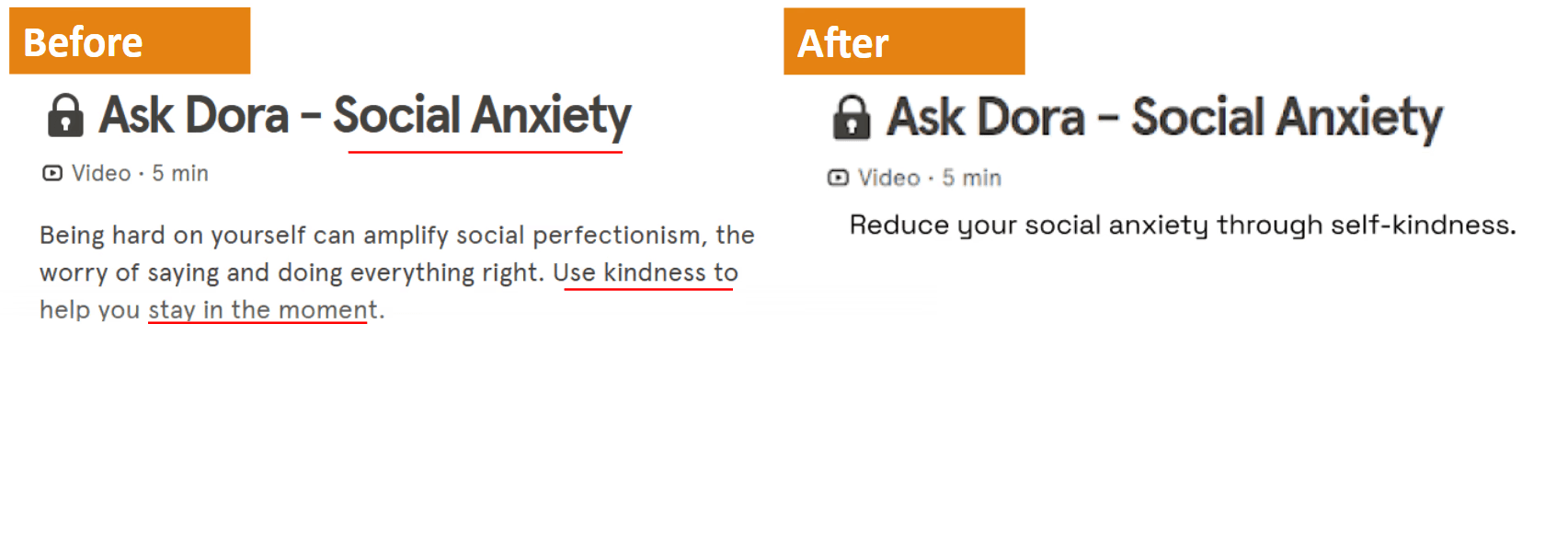
Through these revisions, Headspace’s copy can reflect the smart, trustworthy persona it wants to embody.
Headspace must balance demonstrating its expertise with speaking to users in an approachable way. Using familiar language helps users understand new concepts without creating unnecessary barriers. Keeping actions as verbs rather than turning them into nouns makes it clearer what users can do to find calm. Placing key subjects at the beginning of sentences helps users quickly identify the tools and resources available to them.
If I had the opportunity to test these recommendations, I would begin with A/B testing to measure whether the revised copy improved exercise completion rates. I would also conduct qualitative research, such as user interviews or usability testing, to understand how users responded to the new copy compared with the original.
