Competitive Research
User Flow Mapping
Wireframing
Hi-fi Prototyping
Stakeholder Alignment
In the Summer of 2025, I joined KUGU, a proptech startup that helps property owners manage energy expenses, as a UX Design Intern. The team was developing a new platform for energy monitoring and billing, and they entrusted me with designing one of its core workflows: the cost-exchange process between property managers and billers.

I started by mapping the existing workflow, followed by an ideal version. In the ideal workflow, property managers would enter their information once, and the system would automatically calculate the costs and send the results to billers. At the time, however, neither the engineering team nor the executive team had agreed on the product's direction. Before we could continue designing, we needed a shared understanding of what we could realistically build.
To align the team, I created a presentation that summarized our design progress and key findings. I then facilitated a discussion where we reviewed priorities and constraints together. The executive team explained that they needed to release an updated process by the end of the year. Rather than designing the complete long-term solution, we agreed to focus on the features that would deliver the most value within that timeline. The engineering team outlined the technical limits we needed to work within.
I put together a presentation featuring our design progress and my insights. From there I facilitated a dialogue where we listened to each other's concerns. The executive team voiced their concern that they needed to deliver on an updated process by the end of the year, so rather than trying to build an ideal process, we just needed to focus on implementing the most essential elements. The engineering team provided constraints on what we could accomplish with the time we had.
Together, we decided to build a platform that would simplify cost entry for property managers while continuing to export the results as a PDF. Billers would continue entering the data manually until a future release automated that part of the process.
Based on these decisions, I created two user flows: a lean version that we could implement if time became limited, and a minimum viable product (MVP) flow that reflected our agreed-upon plan.
Lean Flow

The Lean Flow, featuring modifications to the existing AbSys system.
MVP Flow

An MVP flow, where we step away from the AbSys system.
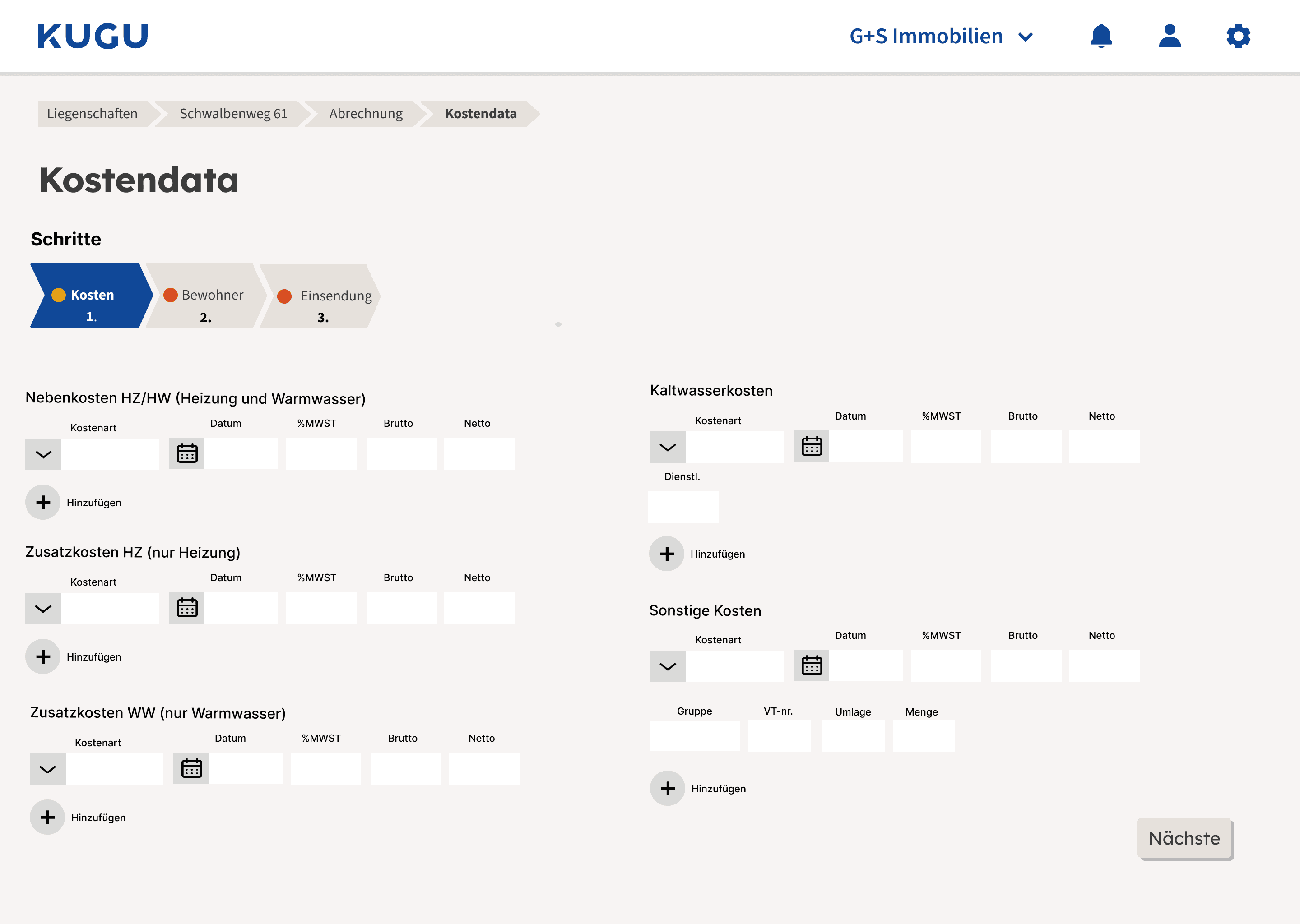
The team and I decided that I should design the first version of the platform as a digital form. With this approach, fields appeared or disappeared based on the user's selections, which reduced unnecessary information on the screen. The design also let property managers add multiple instances of the same cost or create custom cost entries when needed
After each design iteration, I evaluated the interface using heuristic analysis. The most common issues involved error prevention, user control and freedom, visibility of system status, and help and documentation. I addressed these issues by designing features such as required-field validation, clear navigation and cancel actions, a step-by-step progress indicator, and contextual help boxes.
Early Draft Starting Page

Early Draft Cost-Input Page
Starting Page

Heating Costs

Resident List

Although my internship was brief, the work I completed became the foundation for the product that was ultimately launched. After I left, the team expanded the prototype with additional functionality, but the components and page layouts I designed remained largely intact in the MVP. They also provided the foundation for the team's long-term vision of a fully automated workflow.
